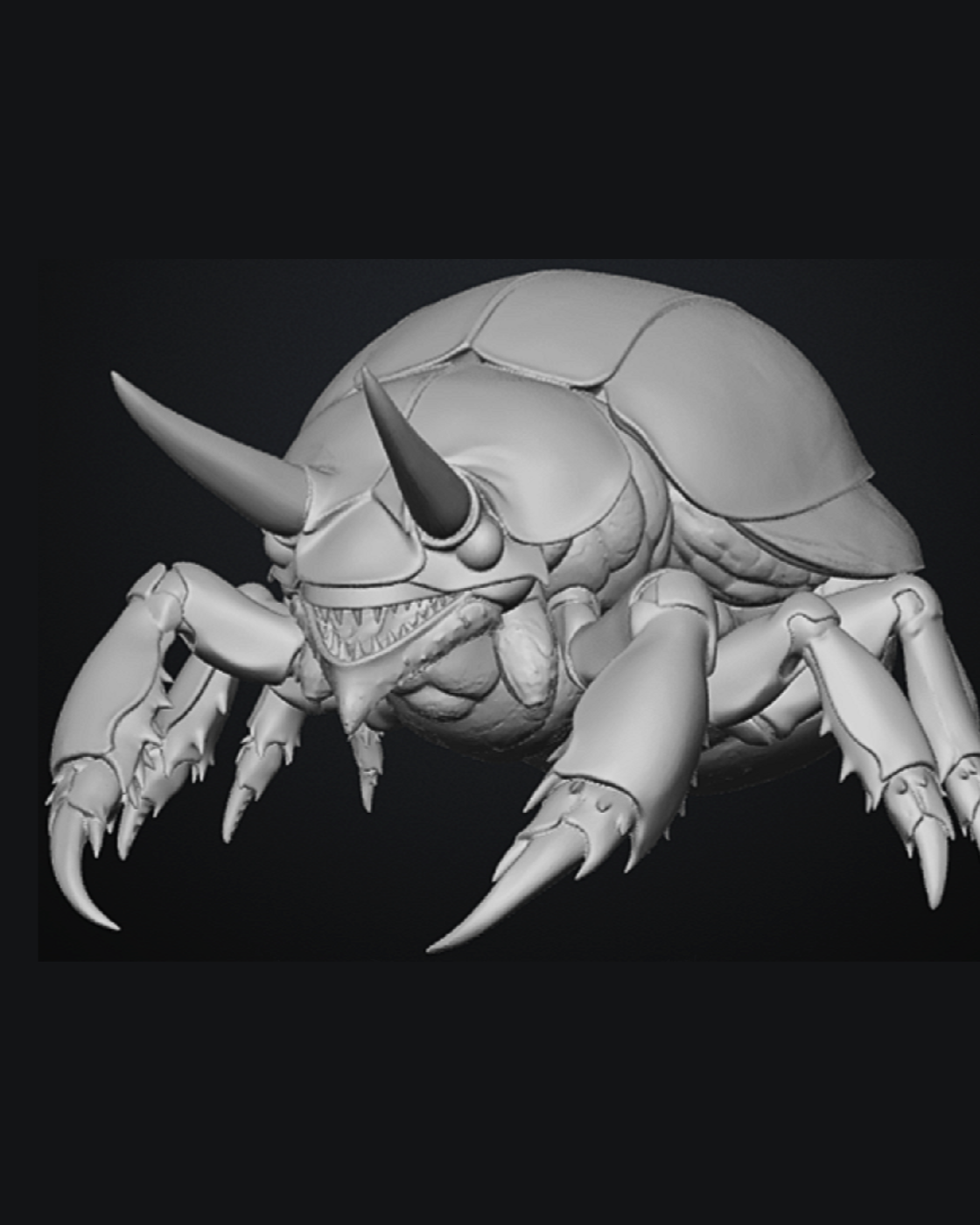
Artist’s Reconstruction of Dar (Digital .STL file format, uncut/unkeyed)
Late Hellite Period (species extinct)
This 3D model reconstructs the creature known as Dar, which appears to have played a recurring role as a companion of Xanthea of Helios. Despite the creature’s prominence in her personal accounts, Dar (as the species is now named) are known only from incomplete archaeological evidence. No intact remains have been recovered, and all reconstructions rely on shell fragments, environmental context, and Xanthea of Helios’s descriptions.
Analysis of these fragments suggests a large, multi-segmented organism approximately two meters in length, adapted for life in communal burrows. The shell's structure implies a balance between mobility and protection, consistent with that of species inhabiting arid or exposed terrain.
Dar are believed to have become extinct after the era known as the Time of Oceans, when widespread ecological collapse altered much of the Martian biosphere. The absence of living examples has left their appearance open to interpretation, placing this reconstruction at the intersection of scientific inference and historical imagination.
Availability: After purchase, you will receive a secure link to the file, valid for 24 hours after the first download.
License: Personal use only. Commercial use prohibited. See our Digital Artifact License for details.
Please review our Return Policy before purchase.
Artist’s Reconstruction of Dar (Digital .STL file format, uncut/unkeyed)
Late Hellite Period (species extinct)
This 3D model reconstructs the creature known as Dar, which appears to have played a recurring role as a companion of Xanthea of Helios. Despite the creature’s prominence in her personal accounts, Dar (as the species is now named) are known only from incomplete archaeological evidence. No intact remains have been recovered, and all reconstructions rely on shell fragments, environmental context, and Xanthea of Helios’s descriptions.
Analysis of these fragments suggests a large, multi-segmented organism approximately two meters in length, adapted for life in communal burrows. The shell's structure implies a balance between mobility and protection, consistent with that of species inhabiting arid or exposed terrain.
Dar are believed to have become extinct after the era known as the Time of Oceans, when widespread ecological collapse altered much of the Martian biosphere. The absence of living examples has left their appearance open to interpretation, placing this reconstruction at the intersection of scientific inference and historical imagination.
Availability: After purchase, you will receive a secure link to the file, valid for 24 hours after the first download.
License: Personal use only. Commercial use prohibited. See our Digital Artifact License for details.
Please review our Return Policy before purchase.